- Villages
Garlasco
The village that was once the “Bulwark of Pavia” now welcomes pilgrims from around the world


Garlasco is one of the most fascinating towns in the Lomellina, a land of rice fields, castles, and ancient pilgrimage routes. Located just a few kilometers from Pavia, this town of more than ten thousand inhabitants preserves centuries of medieval history, testified by a perfectly preserved fourteenth-century tower and by an urban fabric that still bears the traces of the ancient castle. Today Garlasco is also an important stop along the Via Francigena, the spiritual and cultural route that crosses Europe from Canterbury to Rome.
Visiting Garlasco means immersing yourself in a glorious past, walking among the traces of battles and pilgrims, and discovering how a small town of the Po Valley can weave together history, architecture, and hospitality with remarkable authenticity.
The Torrione of Garlasco: the last bastion of the “Propugnaculum Papiae”The medieval castle and its strategic role
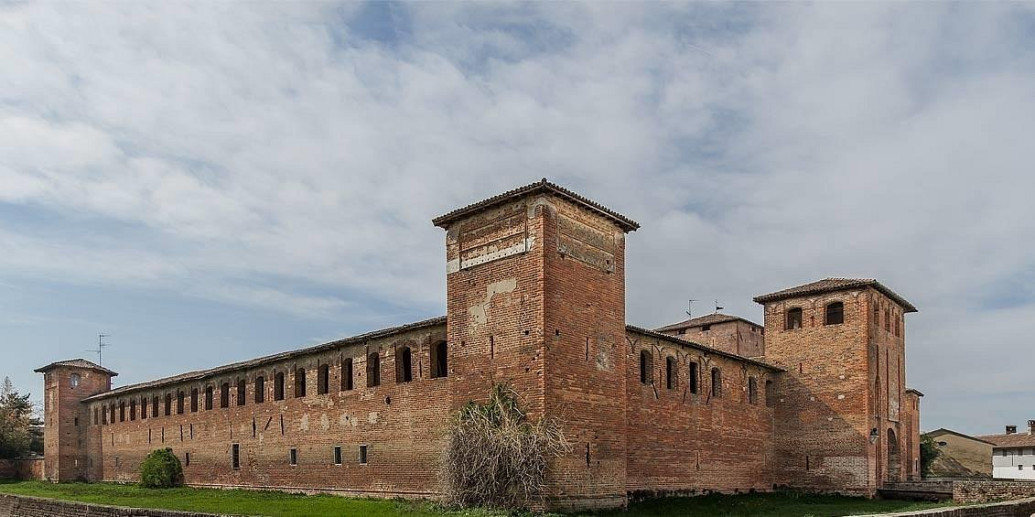
Between the fourteenth and fifteenth centuries, Garlasco was one of the most important defensive centers in the entire Lomellina. Its castle played such a significant role in the defensive system of Pavia that historical documents referred to it as propugnaculum Papiae, literally “the bulwark of Pavia.” This definition reflects the strategic importance of the town, positioned along key communication routes and equipped with a first-rate defensive structure.
According to historical sources, during the fourteenth century a castle was built or rebuilt in Garlasco. Its perimeter can still partly be recognized today in the layout of buildings and in the urban structure of the north-western corner of the oldest part of the town. The strength of its walls and its position made it one of the most important castles in Lomellina—a military outpost capable of controlling movements across the territory and defending the city of Pavia from threats arriving from the west.
The Sack of Garlasco in 1524 and the end of the castle
The history of the Castle of Garlasco took a dramatic turn in 1524, when Venetian troops brought about its destruction. During the conflict known as the “Sack of Garlasco,” the militias systematically dismantled the defensive structures. The famous condottiero Giovanni delle Bande Nere played a leading role in those devastations, which almost completely erased the castle complex.
From that powerful medieval fortress, only one intact and extraordinarily evocative element remains today: the Torrione.
The Torrione: architecture and symbolism
The Torrione rises in Piazza Piccola, in the space behind Piazza della Repubblica, the civic heart of Garlasco. This square medieval tower is a magnificent example of fourteenth-century military architecture and features several elements of great historical and architectural interest.
At its base, an underpass with double-vaulted arches creates a picturesque passage that still runs through the structure today. At the top, the distinctive Ghibelline battlements, recognizable by their swallow-tail merlons, give the tower its original appearance. Elegant saw-tooth brick decorations embellish the masonry, adding refinement to a structure originally designed for war. Still visible are the bolzoni of the drawbridge, stone hooks that once supported the mechanism of the lifting bridge, evidence of the original defensive system.
The restoration of the 1970s: recovering historical identity
After remaining abandoned for decades, by the late 1970s the Torrione was in a serious state of decay. The Municipality of Garlasco undertook a careful and meticulous restoration project that restored the structure to its original medieval appearance. The works brought back to light the battlements and the traces of the bolzoni, previously sealed within the masonry, allowing visitors today to admire the tower in its authentic configuration.
This restoration represents an exemplary intervention, demonstrating how historical heritage—even when apparently lost—can be recovered with care and expertise.
Practical information – Torrione of GarlascoLocation: Piazza Piccola, Garlasco (Province of Pavia) – behind Piazza della Repubblica
Access: The tower can be viewed from the outside and freely reached from the square
Historical period: 14th–15th century (medieval period, Visconti–Sforza era)
Architectural features: Ghibelline battlements, saw-tooth brick decorations, double-vaulted arches, drawbridge hooks
Historical note: Survived the Sack of Garlasco in 1524; restored in the 1970s
A thousand-year-old route in the heart of the Lomellina
The Via Francigena is one of the oldest and most fascinating cultural and spiritual itineraries in Europe. Traveled in the year 990 by Archbishop Sigeric of Canterbury, who was returning from Rome where he had received the Pallium from the Pope, this historic road connects England to the Eternal City, crossing the Alps, the Po Valley, and the Apennines. Garlasco is one of the Lombard stops along this route, which attracts pilgrims and walkers from all over the world every year.
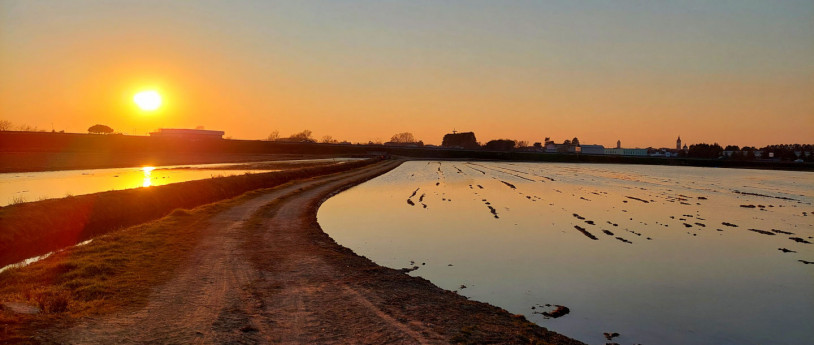
Walking the Via Francigena in this stretch means crossing the Lomellina with its landscapes of rice fields and irrigation canals, breathing in the history of a territory that for centuries has been a crossroads for peoples, armies, and pilgrims. It is an experience that combines spirituality, nature, and cultural discovery in a single unforgettable journey.
The Pilgrims’ House: hospitality and community
Strongly supported by the local administration to provide a concrete reference point for those traveling along the Via Francigena, the Pilgrims’ House of Garlasco was officially inaugurated in June 2022. Since then it has hosted pilgrims from all over the world, becoming a place of meeting and sharing among people of different cultures, languages, and traditions, united by the spirit of the journey.
The facility is a fully renovated apartment equipped with all the comforts needed for a pleasant stay after a long day on the road. The Municipality of Garlasco has made available a three-room apartment consisting of a fully equipped kitchen, two bedrooms, a bathroom, and a common room, for a total capacity of 6–8 beds. The apartment also includes a washing machine and microwave oven, features particularly appreciated by long-distance walkers.
Practical information – Pilgrims’ HouseAddress: Via Santissima Trinità, Garlasco (Province of Pavia) – near the Municipal Library
Opening: June 2022
Capacity: 6–8 beds (2 bedrooms, kitchen, bathroom, common room)
Facilities: Washing machine, microwave oven
Booking: Preferably at least 24 hours in advance
Email: bibliogarlasco@yahoo.it
WhatsApp: +39 334 343 5810
Garlasco is easily reached from Pavia by car (about 20 minutes via the SS596) or by public transport services within the province. The town can be comfortably explored on foot: the historic center is compact and the Torrione stands just a short walk from the main square.
For those traveling along the Via Francigena, Garlasco represents a natural stop along the route. The Pilgrims’ House offers authentic hospitality on a human scale, ideal for those seeking not only a bed but also a moment of rest and connection with the local community.
Combining a visit to the Torrione with a walk through the historic center allows visitors to read in the urban fabric the traces of the medieval castle: the perimeter of the ancient fortress is still partly visible in the shape of the blocks and in the orientation of the streets in the north-western corner of the oldest settlement.
Garlasco in the context of the LomellinaGarlasco lies at the heart of the Lomellina, one of the most characteristic subregions of the Province of Pavia. This plain, crossed by irrigation canals and dominated by rice fields, has an ancient history: already inhabited in pre-Roman times, during the Middle Ages it became a contested territory between the great powers of the Po Valley—Milan, Pavia, and Venice—and was dotted with castles and watchtowers.
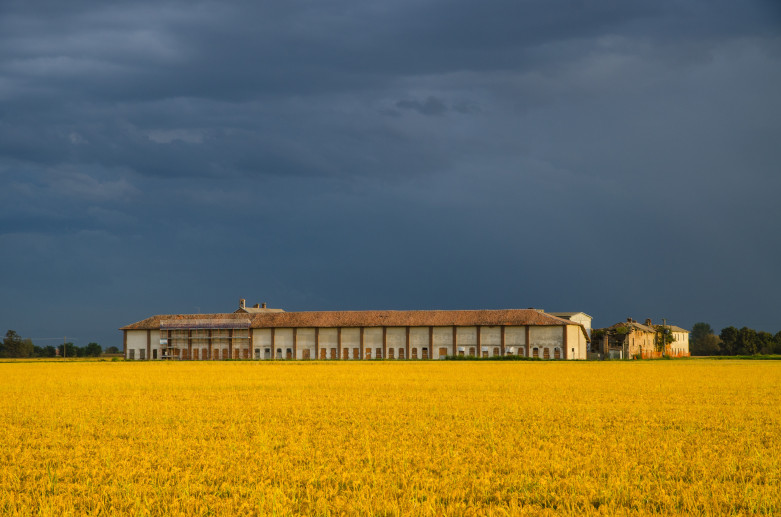
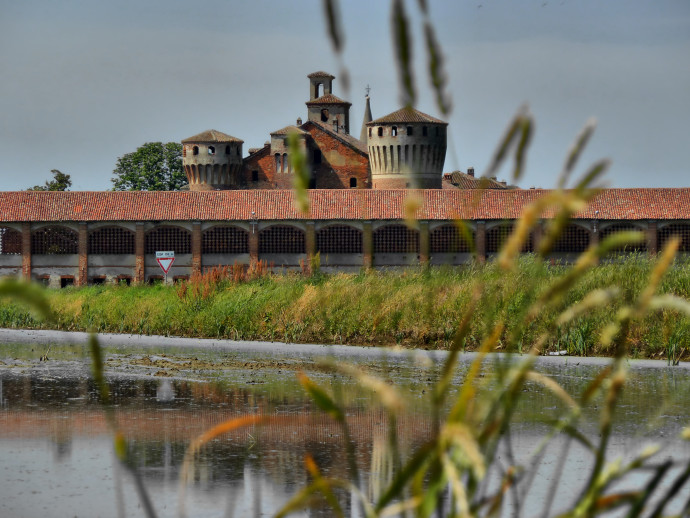
The landscape of the Lomellina, with its rice fields that in summer turn into vast mirrors of water and its large traditional farmsteads, offers a unique visual and sensory experience. Visiting Garlasco also means discovering this territory, its rice-based gastronomic traditions, and the many historic villages that surround it.
info: www.vivigarlasco.it