- Art & Culture
The University of Pavia Archaeological Museum


Pavia holds many places where history can be walked through, and few surprise visitors as much as this one. Since 2 October 2026, the University of Pavia's Archaeological Museum has been open to the public again, and a visit now has a new charm.
A Reopening That Is Already a Story
After a major restoration, the historic Crociera (Cross-Vault Hall) of the fifteenth-century San Matteo Hospital, home to the collection, has finally reopened its doors. The museum had been closed since December 2023 for the renovation of the University's Palazzo Centrale, and throughout that time its artefacts were kept in a secure storage facility. Their return began in June 2026.
The new display, entitled "Lavori in corso" ("Work in Progress"), hides nothing of this story. Conceived by the architect and museographer Massimo Ferrari, it stages the very crates in which the objects were safeguarded over the past two years: placed at the centre of the rooms, they become the visual focal point of the visit, while the original historical arrangement of the collection is preserved. Not all the crates are open. Some will reveal their contents in the future because, as the museum's director Elena Calandra reminds us, a museum only lives if it is able to transform itself. The temporary itinerary is therefore an open worksite leading toward the final installation, and those who visit today witness a museum in the act of reinventing itself.
A Hall Holding Six Centuries of History
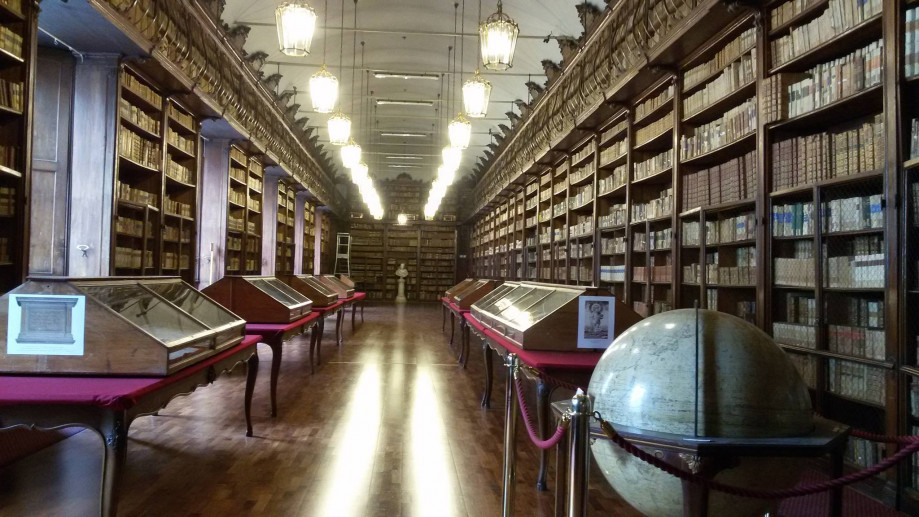
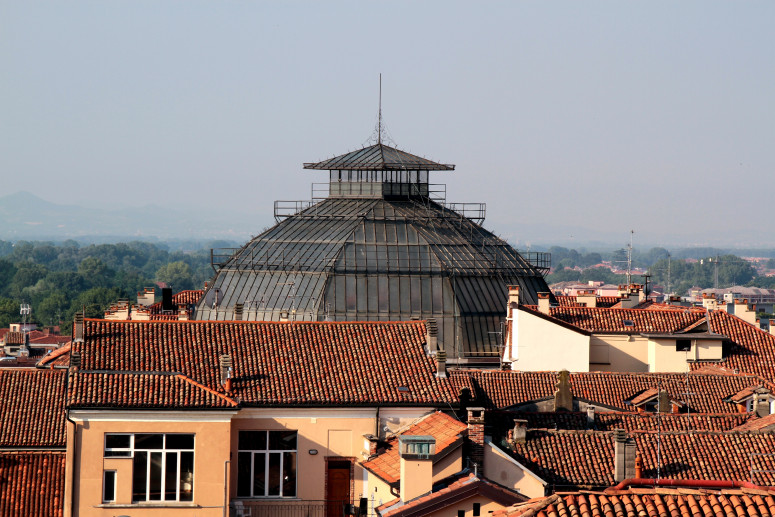
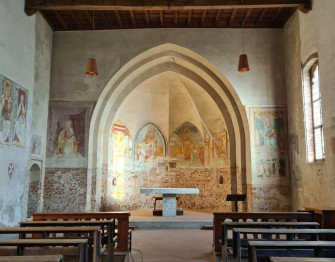
The setting alone is worth the trip. The museum occupies the Crociera of the fifteenth-century San Matteo Hospital, where four sections of the original wooden ceiling survive, along with a small Baroque dome built in 1770 to bring more light and air to the sick. Here, beneath vaults designed to heal bodies, the traces of ancient civilisations are now studied and admired.
Two Hundred Years of Collecting and Research
The museum was born with the first chair of archaeology established in Italy, in 1820, entrusted to Pietro Vittorio Aldini, and it has retained a strong educational character from the outset. It is one of the oldest university archaeological collections in the country. The collections span prehistory, Egypt, the civilisations of ancient Italy and the Roman age, up to the Renaissance, and include an important cast gallery.
Among its best-known pieces is the head of the Aphrodite Sosandra. It is a Roman copy of the second century AD, of exceptional quality, after a bronze original by the sculptor Calamis, datable to around 460 BC, which stood in the Propylaea of the Acropolis in Athens. Alongside the sculpture are Magna Graecian, Etruscan and Roman ceramics, Etruscan terracotta votive offerings, and collections of coins and engraved gems. The coins, mostly Roman Republican and Imperial, include the collection assembled in the eighteenth century by the Bellisomi marquises, members of the Pavian aristocracy, and donated to the University in 1821.
A Living Museum: Schools, Research and Culture
The museum continues to be a place of study and of dialogue with the local area. It looks to the future as a centre with an international outlook, with collaboration and research projects currently being defined and constant engagement with schools in the region. Direct contact with original artefacts and casts allows students and visitors alike to get closer to the methods of scientific research.
The events programme has already resumed. On Friday 9 October 2026, at 5.30 pm, the museum hosts "L'arte di incontrare l'altro. I Greci e la geografia della fiducia" ("The Art of Meeting the Other: The Greeks and the Geography of Trust"), an event of the IT.A.CÀ Festival dedicated to migrants and travellers.
Visitor Information
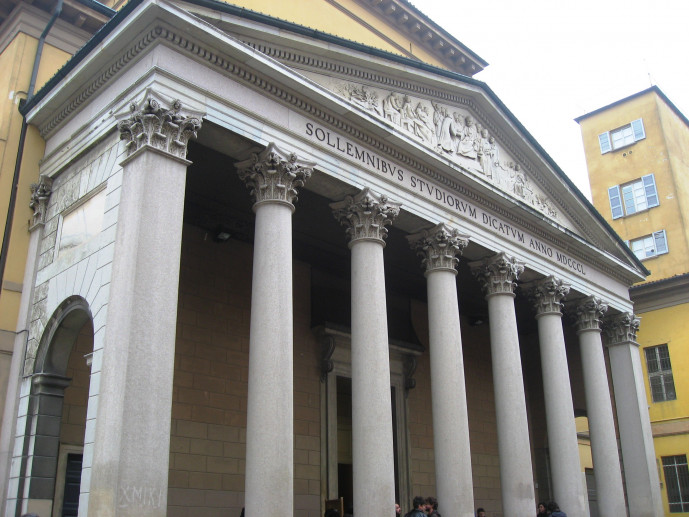
The museum is located in the University's Palazzo Centrale, at Strada Nuova 65, a short walk from the historic centre and the railway station. The entrance is in the passage between the Cortile delle Magnolie and the Cortile Sforzesco. For information and to book guided tours and educational workshops, write to museo.archeologia@unipv.it or call +39 0382 984199. Before setting out, we recommend checking opening hours and ticket prices on the museum's official website, as the opening schedule is being updated following the reopening.
For those who love Pavia, the Archaeological Museum is an invitation to return to a city that preserves, beneath its medieval vaults, a heritage far older than one might imagine.
Other links
FacebookBiglietti e orari