- Art & Culture
- Religious Tourism
Church Of Saint Giovanni Domnarum
One of the oldest churches in Pavia

On Via Mascheroni, just steps from the Church of the Carmine and directly opposite the Taramelli science high school, an almost anonymous façade conceals one of the most surprising sites of Lombard-era Pavia. This is the Church of San Giovanni Domnarum, one of the oldest in the city, which holds beneath street level an early medieval crypt rediscovered only in 1914, after centuries of oblivion. Reused Roman capitals, twelfth-century frescoes and even a small hoard of silver coins make this understated yet precious complex one of the most fascinating stops for anyone wanting to know Pavia beyond its best-known trails.
A church hidden in the heart of the city
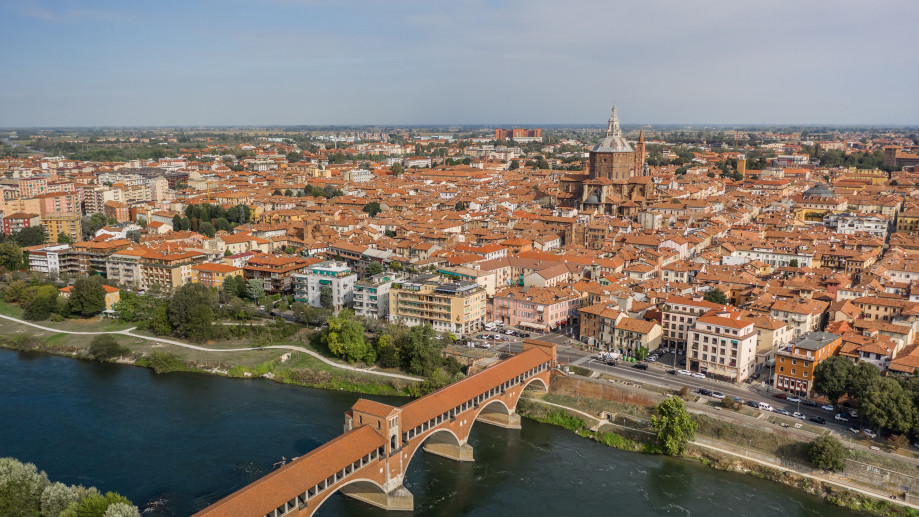
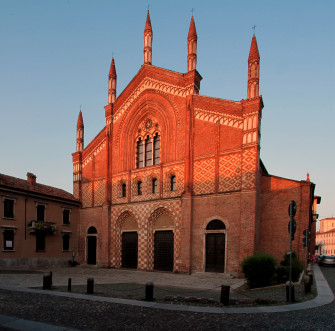
The San Giovanni Domnarum complex stands in the very heart of Pavia's historic centre, on Via Mascheroni, with its historic entrance at number 9 Vicolo San Giovanni. The façade is embedded within a residential building and does not face a square, but an internal courtyard, through which visitors reach the small forecourt: an unusual layout that explains why even many residents of Pavia are unaware of this place. The complex includes the church, the Romanesque bell tower and the crypt, three elements that tell very different construction stories, from the early Middle Ages to the seventeenth century.
Lombard origins: the foundation by Queen Gundeperga
Tradition traces the church's foundation to around 654, by will of Queen Gundeperga, wife of Rotari and, in a second marriage, of Arioald, and daughter of Queen Theodolinda and Agilulf. Gundeperga is said to have wanted the church either as the site of her own burial, or as the seat of a baptismal font reserved for women: this would explain the qualifier "Domnarum", meaning "of the women", alongside the dedication to Saint John the Baptist. It was, in all likelihood, the first Catholic building erected by the Lombard kings in the city of Pavia, then the capital of the kingdom. The church played a leading role in city life until around the year 1000, supported by the substantial endowment granted by its founder, and was administered from the outset by a college of canons.
From Einhard to the imperial diplomas
In the first half of the ninth century, the church was granted in benefice to Einhard, the celebrated biographer of Charlemagne, who himself recounts this in the Translatio et miracula Sanctorum Marcellini et Petri, the work in which he describes the transfer of the relics of the two saints from Rome to Steinbach. Between the ninth and tenth centuries the church was the subject of numerous imperial diplomas recalling its foundation by Gundeperga, while a document issued by the Bishop of Pavia, Bernard I, dated 1129, attests that masses "pro anima" were still being celebrated there in the queen's memory. In the tax records of 1250 the building appears among the parishes of the Porta Palazzo district.
Beneath the church, Roman baths
Archaeological excavations carried out in 1957 in front of the façade brought to light numerous cylindrical suspensurae, the typical elements of Roman heating systems, also found inside the crypt. The church was therefore built over the remains of a late-antique Roman bath building. This evidence, however, is not enough to prove the existence of a genuine public bath complex: it could equally have been the heated rooms of a high-status private domus, a sign in any case of the importance of this part of the city already in Roman times.
Transformations between the Middle Ages and the early modern period
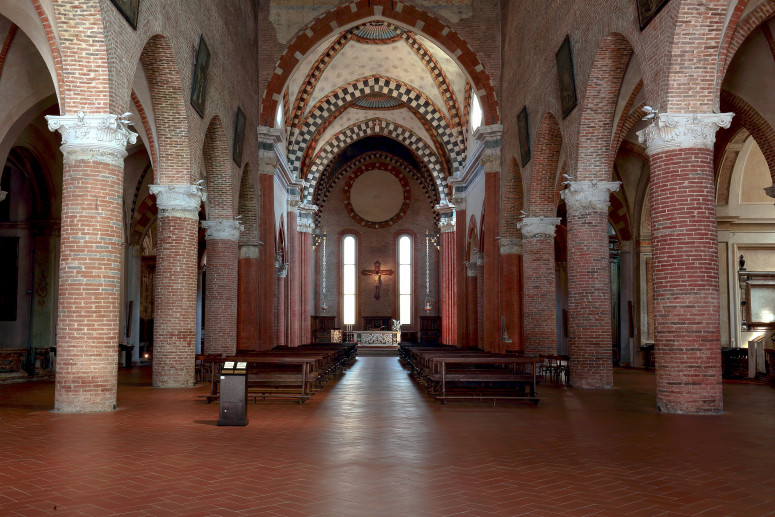
In 1346 the nearby church of San Colombano Minore was suppressed. Of Lombard foundation and originally entrusted to the monks of Bobbio, it stood where the Church of the Carmine stands today; its revenues passed to the provost and chapter of San Giovanni Domnarum. The pastoral visits of Amicus de Fossulanis (1460) and Angelo Peruzzi (1576) document the life of the parish: in 1576 it counted 250 souls of communion age and was served by eight canons and seven chaplains, while by 1769 the parish was served by seven priests and seven clerics. A decisive intervention came in 1611, when the provost Torriani, in order to adapt the Romanesque building to the liturgical requirements set out by the Council of Trent, promoted works that heavily altered its appearance: the three original naves were partly demolished and the church took on its current form, a single nave with side chapels, while the crypt and bell tower fortunately remained intact. In 1788, under the reorganisation of urban parishes ordered by Emperor Joseph II, the parish was suppressed and merged with that of the Cathedral, becoming one of its subsidiary churches.
The fifteenth-century façade and the Romanesque bell tower
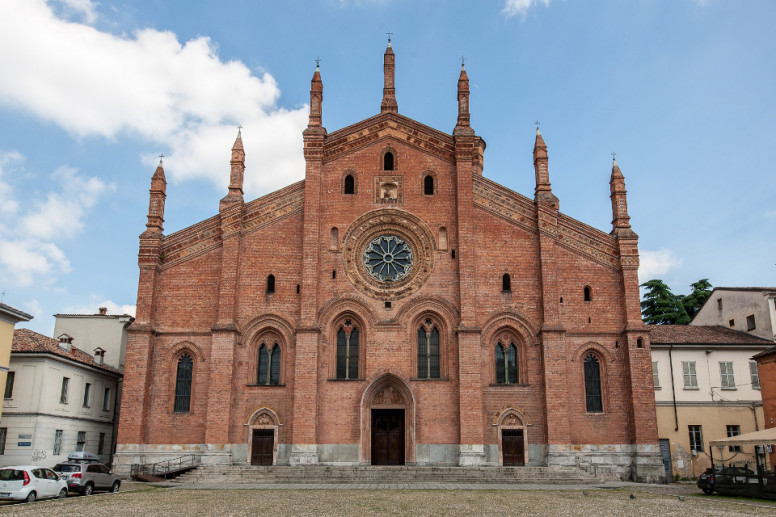
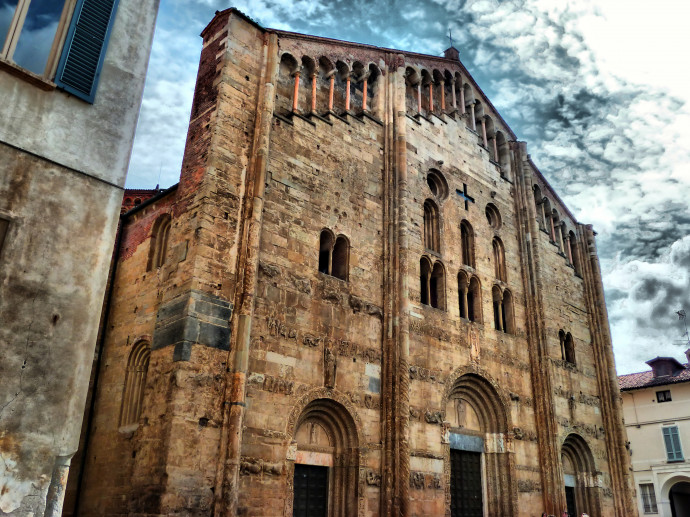
The façade, dating from the fifteenth century, features in its central band a terracotta rose window flanked by two smaller rose windows. Considerably older is the bell tower, datable to the mid-eleventh century, which stands as the true identifying feature of the complex: its construction decoratively reuses various materials of Roman origin, especially in the section near the bell chamber. It follows a model widely found in Pavia and Milan, with a sequence of hanging arches framing simple single-light windows and, in the topmost section, a belfry with mullioned two-light windows.
The artworks in the seventeenth-century interior
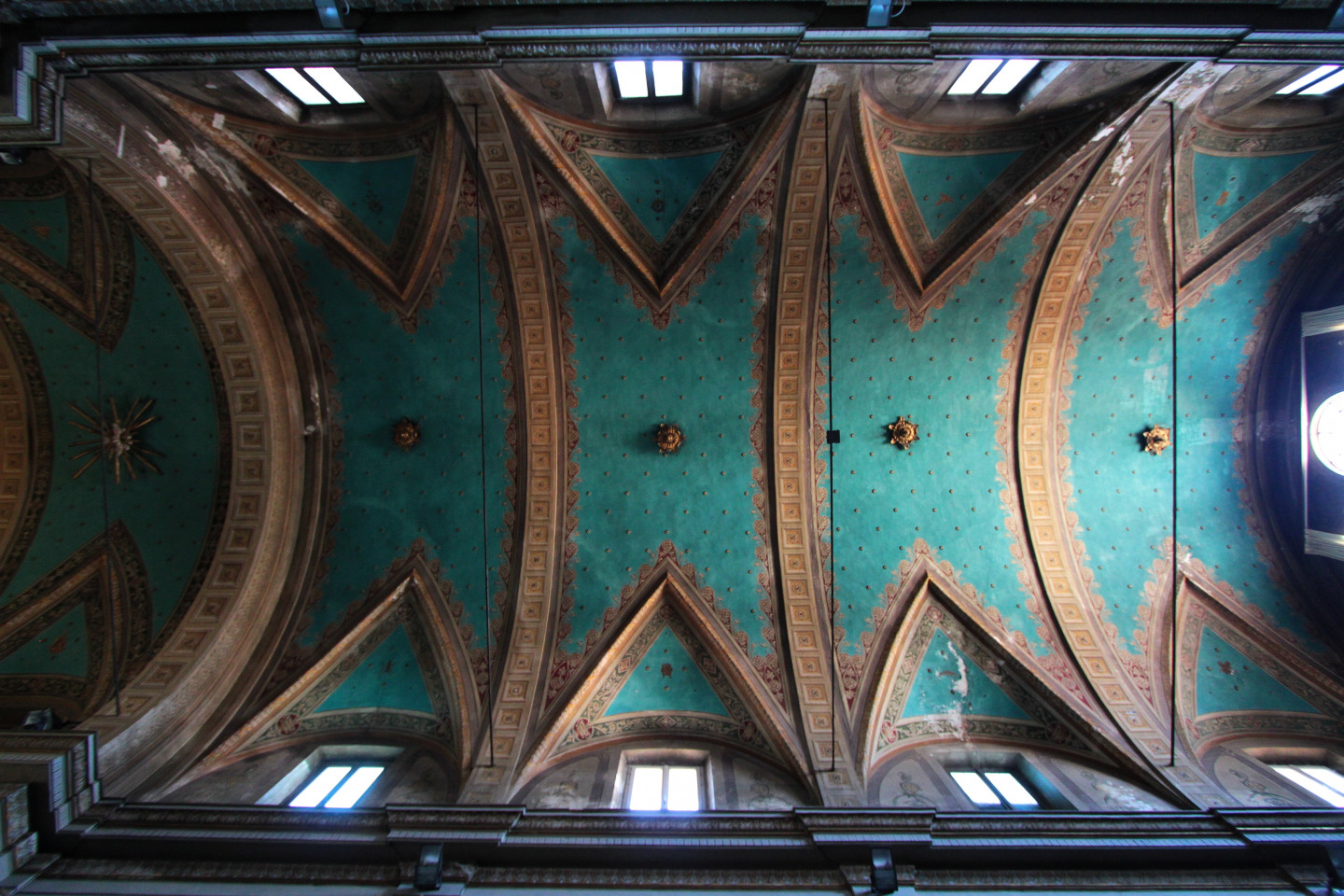
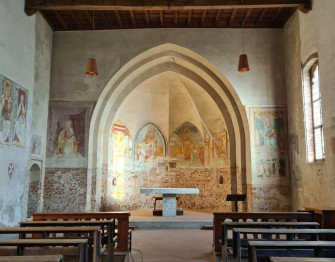
The interior, the result of the 1611 reconstruction, has a single nave with side chapels and a square-plan choir. In the first chapel on the right is an altarpiece by the Milanese painter Giovan Battista Sassi, depicting Saint Andrew Avellino stricken before the altar. In the lunette of the presbytery is a fresco of God the Father, the work of Federico Faruffini. In the second chapel on the left is kept an altarpiece of Saint Nicholas, coming from the former church of San Nicolò della Moneta, while a mid-eighteenth-century canvas by the Pavia painter Giuseppe Gatti depicts Queen Gundeperga presenting the design of the church to Saint John. Beneath the high altar are kept the relics of Saint Blaise, a saint greatly venerated by the people of medieval Pavia, and traces of an ancient frescoed wall hanging can still be seen along the perimeter walls. In the upper part of the main nave and in one side bay, remains of masonry and frescoes from the Romanesque building are still visible.
The crypt: the most authentic part of the building
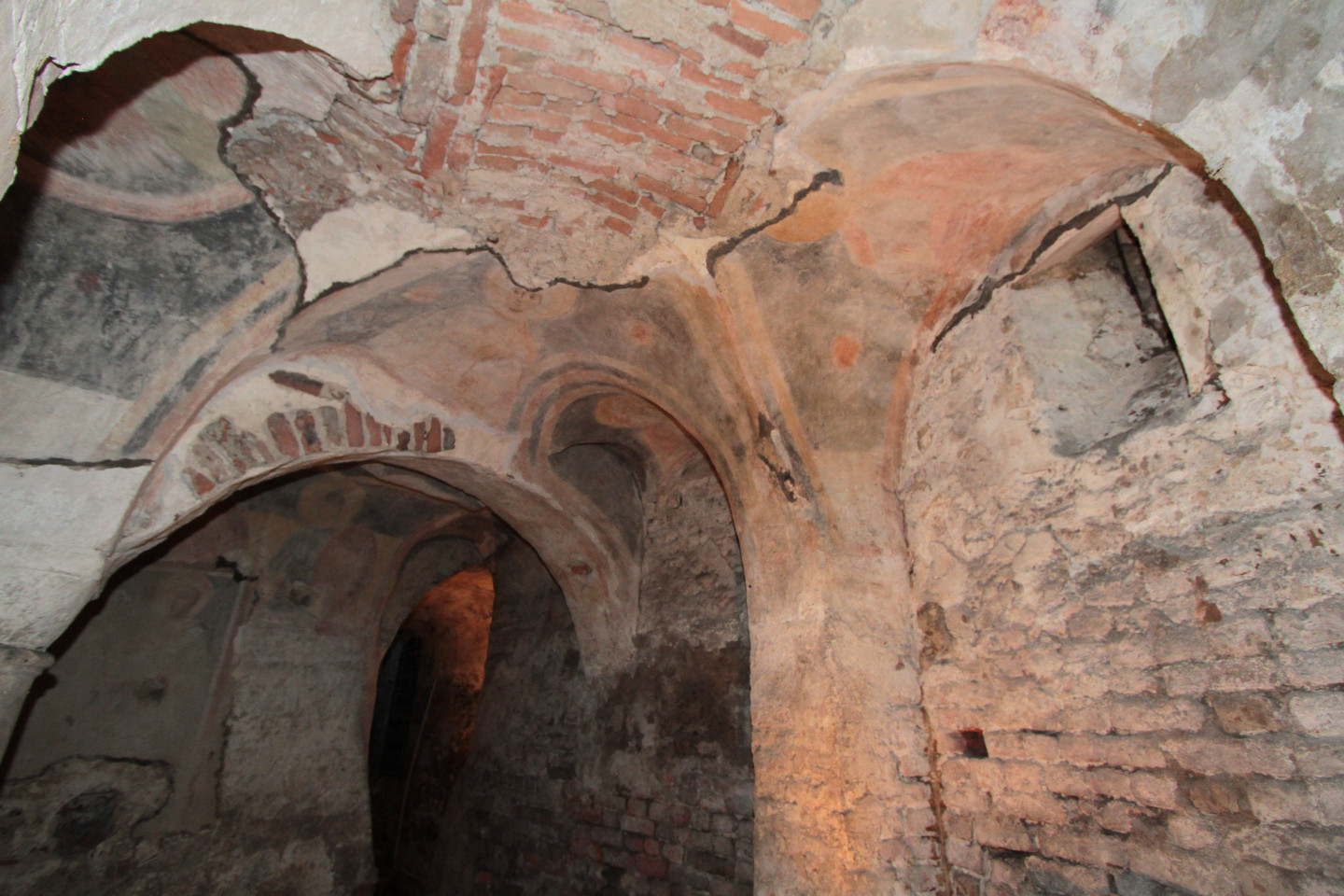
The crypt was probably built in two phases: the first, in the mid-tenth century, reusing the wall remains of the first Lombard church; the second, in the early decades of the eleventh century, when the space was extended eastward. Most of the supports are trapezoidal in shape and have neither capitals nor corbels, with the exception of the four columns framing the altar: these bear reused capitals, partly of Roman origin — including a fourth-century Corinthian capital — and one of Lombard date, from the eighth century, decorated with plant motifs. Following the works carried out in 1611, the crypt was sealed off and used only as an ossuary, remaining inaccessible for centuries.
The 1914 rediscovery
The crypt, buried for centuries and reduced to a burial vault, came back to light on 18 April 1914 thanks to the initiative of Monsignor Faustino Gianani, who, following clues from various historical sources, had a tunnel dug from the courtyard behind the church. During the works, the level of the original medieval floor was not recognised among the rubble and was inadvertently removed: for this reason the current floor of the crypt is lower than the original one and corresponds to that of the ancient Roman thermal environment, where the hypocaust of a calidarium once stood, later used in the Middle Ages as a source of bricks and building materials.
The twelfth-century frescoes
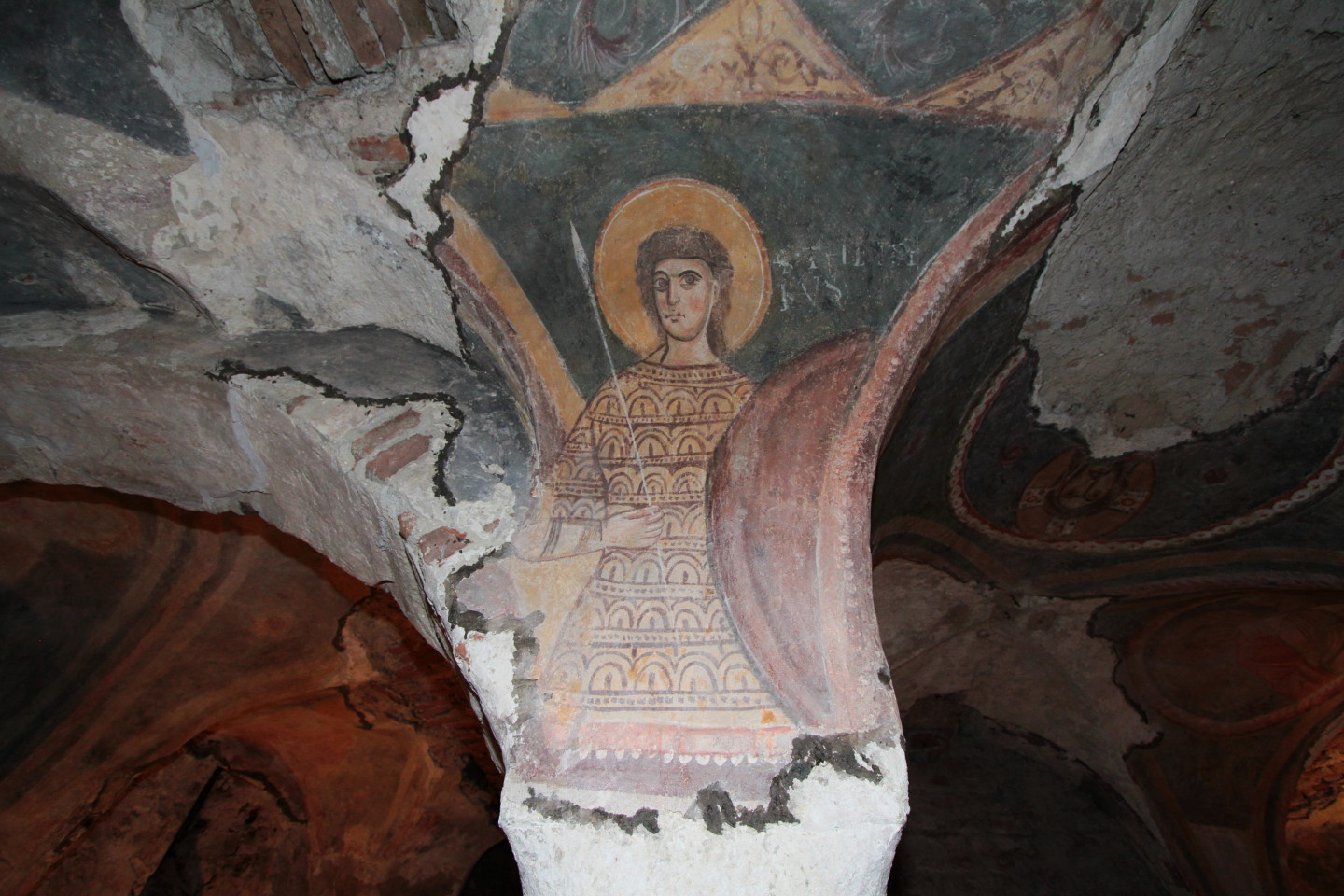
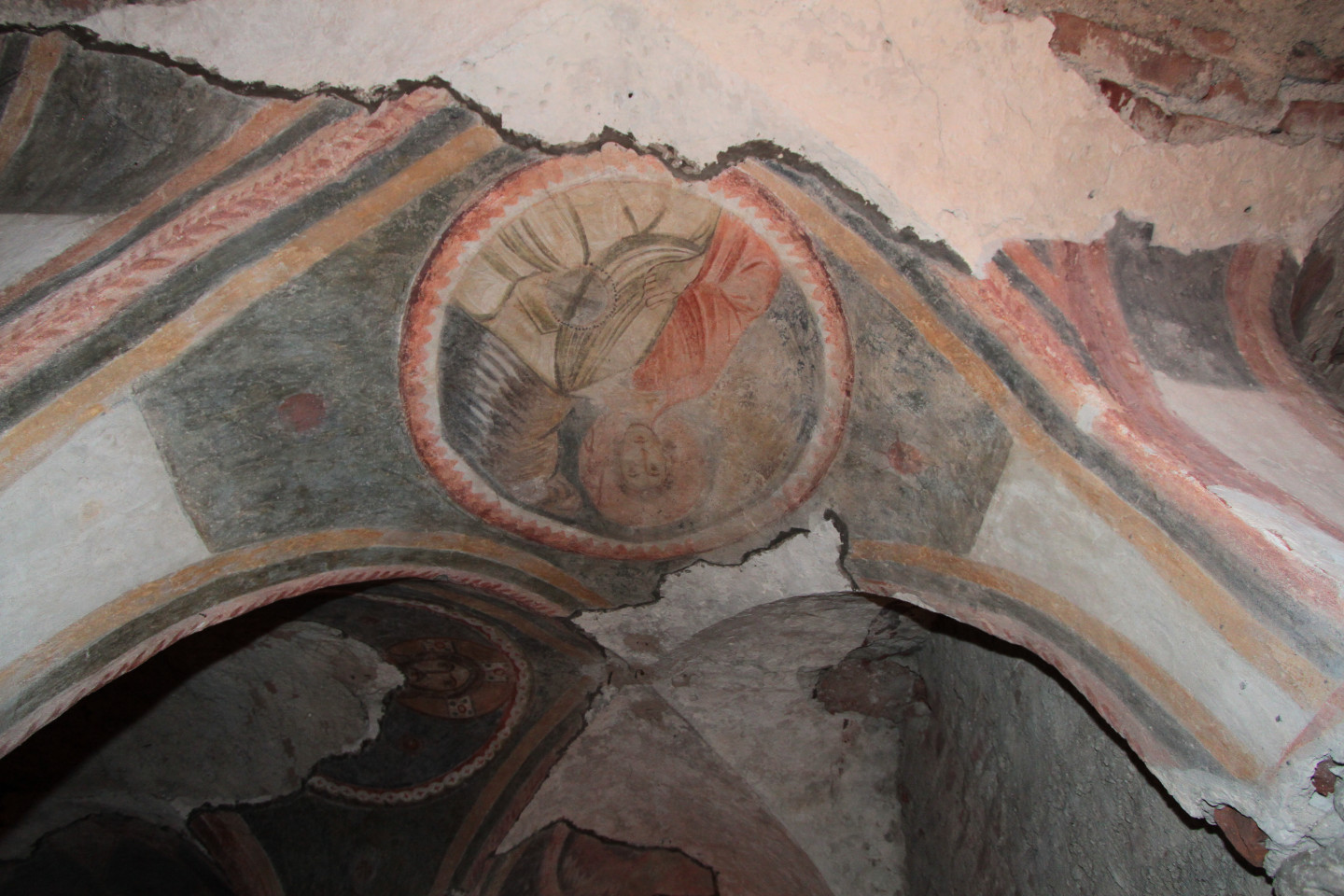
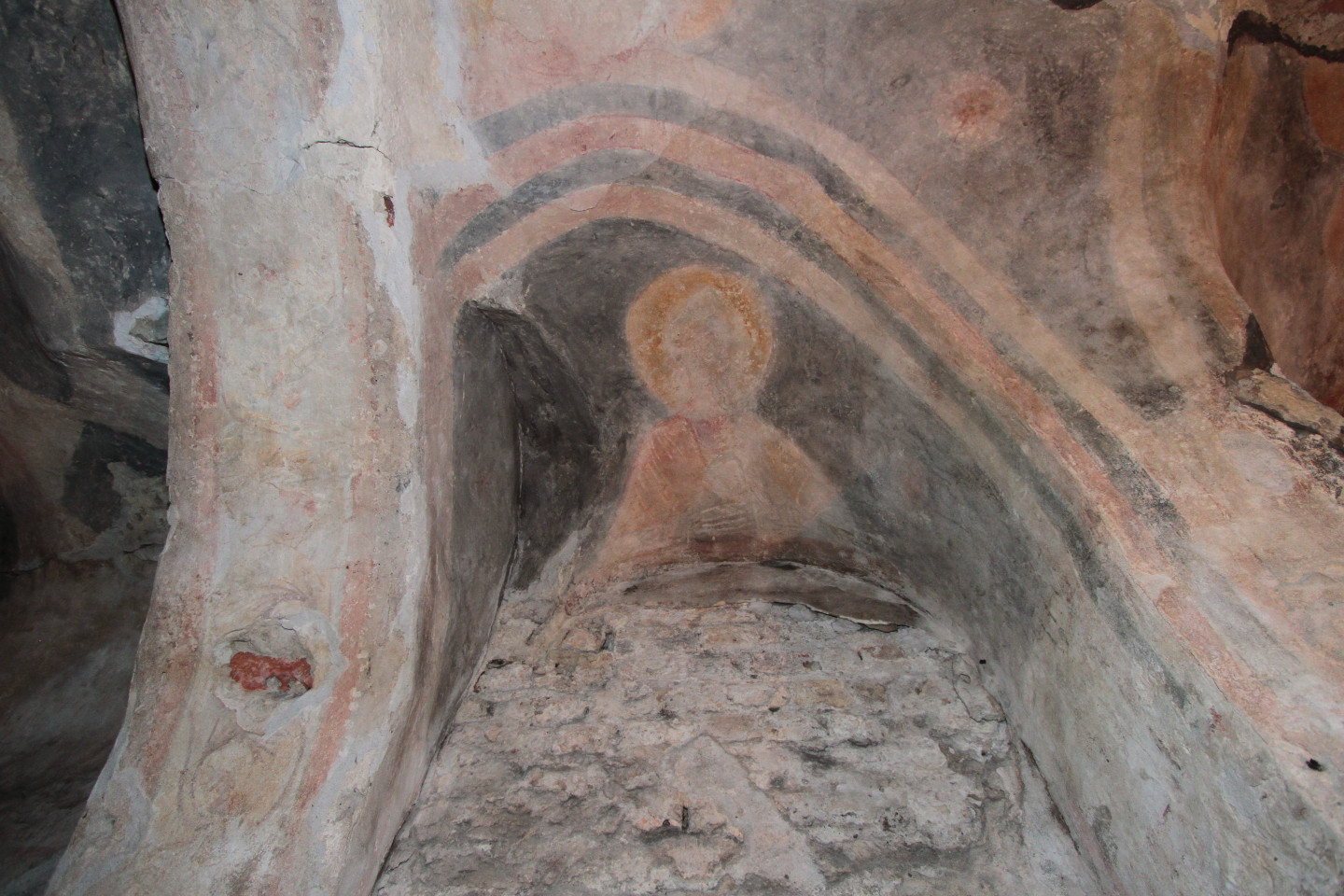
The frescoes in the crypt, datable to the second half of the twelfth century, mostly depict saints linked to the local Pavia tradition: on the pillar to the right are Saint Syrus and Gregory the Great, the latter holding a book, while on the pillar facing it appears the figure of Saint Invenzio, the city's second bishop. There is also a scene, unfortunately very damaged, dedicated to the life of Saint John the Baptist. On some walls and vaults, remains of plaster painted yellow with red inscriptions survive, datable already to the tenth century.
The hoard of silver coins
Inside the crypt, 400 silver denari were also found, kept in a terracotta jar painted black. Some of the coins were minted at the Pavia mint under Emperors Henry III and Frederick II, while another coin was issued by the Bishop of Le Puy-en-Velay in the twelfth century: a small hoard that speaks to Pavia's economic and religious ties with medieval Europe.
An unresolved mystery: where does King Rotari rest?
A fascinating question remains open regarding Gundeperga's husband, King Rotari: according to some hypotheses he was buried in the Basilica of San Giovanni Battista in Monza, while more recent studies suggest San Giovanni Domnarum itself, or the Church of San Giovanni in Borgo, also in Pavia, as his burial site. Some historians further believe that San Giovanni Domnarum itself could be identified with the ancient Basilica of San Giovanni Battista recorded in historical sources — a still-debated piece of the puzzle of Lombard Pavia, once a royal capital.
How to visit the Church of San Giovanni Domnarum
The church stands on Via Mascheroni, with its historic entrance at 9 Vicolo San Giovanni, opposite the Taramelli science high school and just steps from the Church of the Carmine, in the heart of Pavia's historic centre. It is open every day from 7 a.m. to 7 p.m., except during Mass (on weekdays at 9:30 a.m., on holidays at 10:30 a.m.). The crypt is always freely open to visitors, with no booking required, and is occasionally included in guided itineraries, such as those organised by the Touring Club Italiano exploring Lombard and Romanesque Pavia.
Frequently asked questions about San Giovanni Domnarum
When was the Church of San Giovanni Domnarum built?
Tradition places its foundation around 654, by will of the Lombard queen Gundeperga. The church's current appearance, however, is largely the result of the reconstruction ordered by provost Torriani in 1611, while the crypt and bell tower date respectively to the tenth-eleventh century and the mid-eleventh century.
Why is the church called "Domnarum"?
"Domnarum" is a Latin form meaning "of the women". According to the most widely accepted hypothesis, the name derives from the presence of a baptismal font reserved for women; another reading links it instead to the retinue of handmaidens (the "domnae") who accompanied Queen Gundeperga.
What can you see in the crypt of San Giovanni Domnarum?
In the crypt you can admire reused capitals of Roman and Lombard date, twelfth-century frescoes depicting Pavia saints, and remains of the ancient floor at the level of the Roman hypocaust. The crypt was only rediscovered in 1914, after being used as an ossuary for centuries.
Can the crypt be visited for free?
Yes: the crypt is always freely open to visitors and requires no booking, while the church is open every day from 7 a.m. to 7 p.m., except during religious services.
Where is the Church of San Giovanni Domnarum and how do you get there?
It stands on Via Mascheroni, in Pavia's historic centre, with its entrance at 9 Vicolo San Giovanni, opposite the Taramelli science high school and a short walk from the Church of the Carmine.
Opening hours
The crypt can always be freely visited, without reservations.
Every day from 7 a.m. to 7 p.m.
During the celebrations visits at the Cathedral are prohibited (on weekdays 9.30, on public holidays 10.30).
Other links
Virtual Tour