- Art & Culture
- Religious Tourism
Basilica of San Michele Maggiore
The church where the kings of Italy were crowned


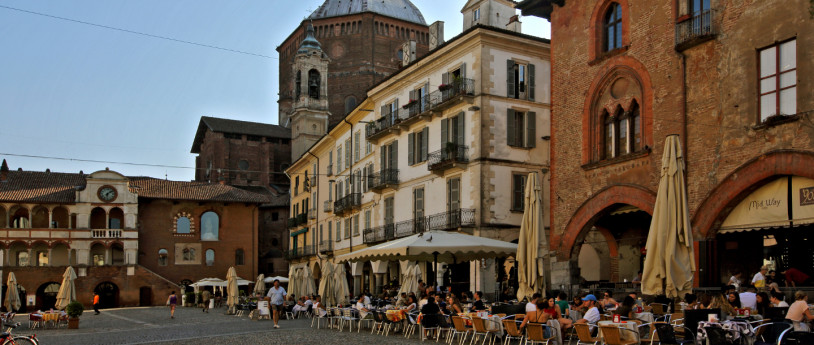
In the heart of Pavia's historic centre, just a short walk from the Ticino River, stands one of the finest masterpieces of Lombard Romanesque architecture: the Basilica of San Michele Maggiore. More than simply one of Lombardy's most beautiful churches, it is also one of the most significant monuments in medieval European history. For nearly five centuries, this was the place where the Kings of Italy were crowned, at a time when Pavia was one of the peninsula's leading political capitals.
Today, visitors are captivated by its magnificent sculpted façade, remarkable medieval floor mosaics, atmospheric crypt and the many traces of a past in which art, faith and political power were closely intertwined.
A Thousand Years of History: From the Lombards to the Kingdom of ItalyThe origins of the Basilica of San Michele are still the subject of historical research. The church certainly existed during the Lombard period and is mentioned by Paul the Deacon in his Historia Langobardorum as one of the principal religious buildings of Lombard Pavia. It stood beside the Royal Palace, a vast palace complex of Late Roman origin that was later expanded by the Ostrogothic and Lombard rulers, maintaining a close relationship with the royal court for centuries.
According to one historical hypothesis, an earlier church may already have stood here in the early sixth century during the episcopate of Ennodius. However, archaeological evidence has not yet made it possible to establish its exact origins with certainty.
Following the Frankish conquest, San Michele became the palace church of the Kingdom of Italy. A devastating fire in 1004 severely damaged the building, which was subsequently rebuilt and became known as San Michele Maggiore ("Greater St Michael") to distinguish it from another church dedicated to the Archangel.
The basilica visible today is largely the result of the major reconstruction undertaken after the catastrophic earthquake of 1117 and completed during the first half of the twelfth century. The bell tower is the most significant surviving element of the earlier medieval church, while several ancient architectural fragments were reused in the new building.
The Church of the Kings of ItalyWhen Pavia served as the capital of the Lombard Kingdom and later of the Kingdom of Italy, the Basilica of San Michele Maggiore became the ceremonial setting for royal coronations.
Medieval sources, including the Honorantiae Civitatis Papiae, describe how kings were crowned on a group of circular stones set into the central nave, following a ceremony inspired by the imperial coronation rites celebrated at St Peter's Basilica in Rome.
The floor still preserves an extraordinary mosaic featuring four circles of black marble surrounding a central circle containing a figure traditionally interpreted as the Iron Crown, the ancient symbol of Italian kingship. A Latin inscription commemorates the site where the royal throne once stood.
Among the rulers crowned here were Berengar I, Louis III, Rudolf II of Burgundy, Hugh of Provence, Berengar II and his son Adalbert, Arduin of Ivrea and Henry II.
The final royal coronation took place on 17 April 1155, when Frederick Barbarossa was crowned King of Italy within the newly rebuilt basilica, only days before his imperial coronation in Rome.
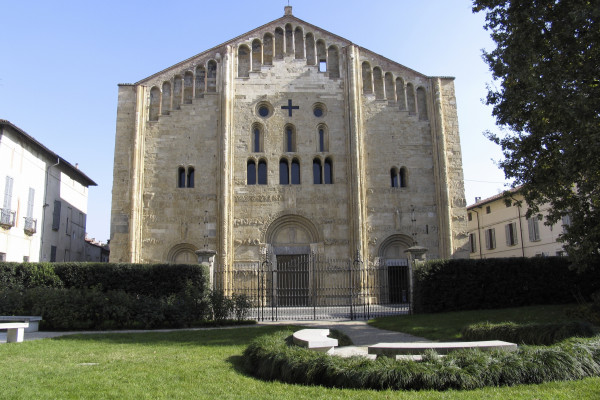
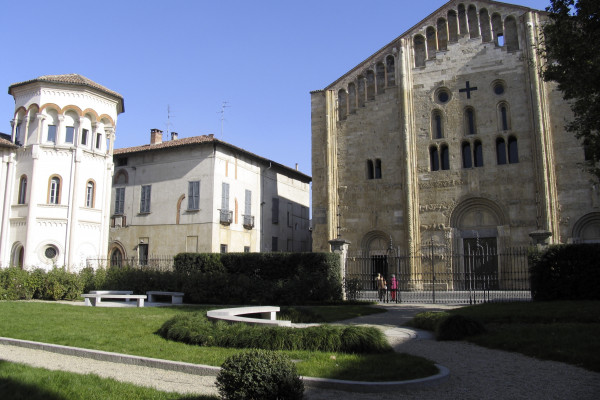
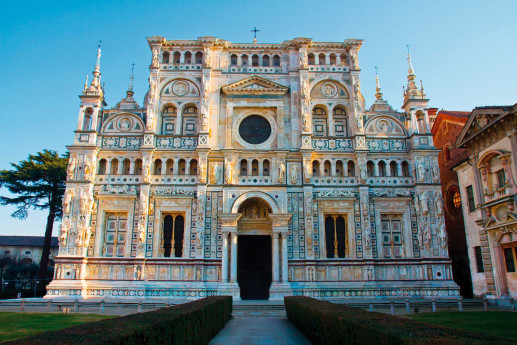
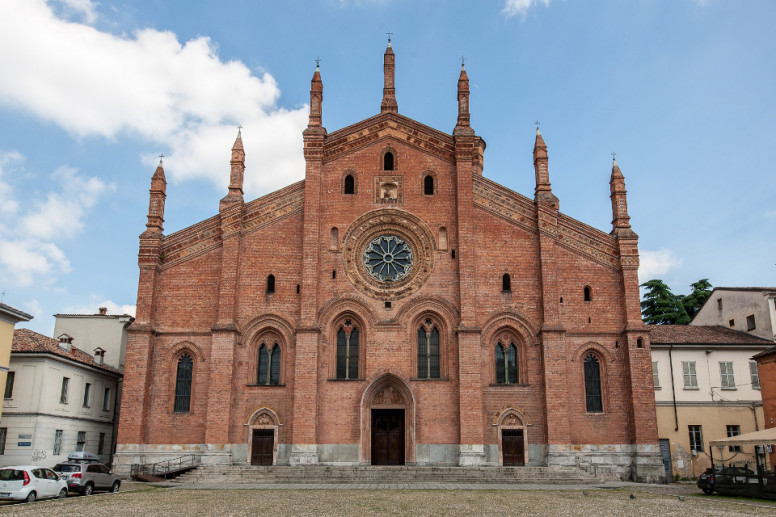
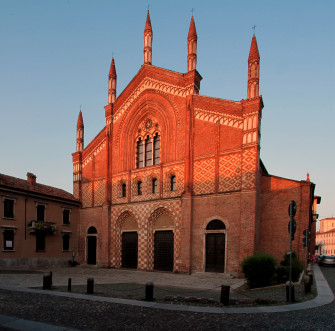
A Façade Rich in Medieval SymbolismThe façade of San Michele Maggiore is regarded as one of the masterpieces of Lombard Romanesque architecture. Built from sandstone quarried in the Oltrepò Pavese, probably near Santa Giuletta, it is admired for its harmonious proportions and its extraordinary sculptural decoration.
Four massive pilasters divide the façade into three sections corresponding to the three interior aisles, while an external gallery runs along the roof slopes, representing one of the earliest examples of this architectural solution in Romanesque Europe.
Originally, the lower part of the façade was entirely covered with carved reliefs depicting biblical scenes, mythical creatures, zodiac signs and symbolic figures. Warriors, double-tailed sirens, King David playing the harp, Adam and Eve, fantastic beasts and numerous allegorical images transformed the church into a true "book in stone", conveying religious teachings to medieval worshippers.
Centuries of weathering, together with the natural fragility of the sandstone, have worn away many of these sculptures, leaving only part of their original richness visible today.
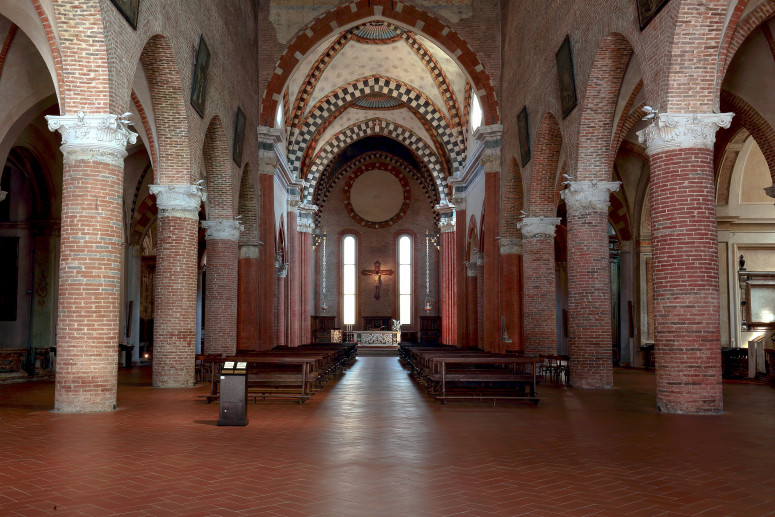
Exploring the InteriorStepping inside the basilica, visitors are welcomed by a spacious and solemn interior defined by powerful piers supporting the Romanesque vaults and by the impressive gallery running above the side aisles. The original purpose of this architectural feature is still debated by art historians.
The Mosaic of the Months and the Medieval Labyrinth
One of the basilica's greatest treasures is the floor mosaic of the presbytery, rediscovered in 1972. It is considered one of the most important surviving Romanesque floor mosaics in northern Italy.
At its centre sits the so-called King Year, enthroned and surrounded by personifications of the twelve months, each represented through seasonal agricultural activities.
Nearby lies a remarkable twelfth-century unicursal labyrinth. At its centre Theseus is shown slaying the Minotaur, an image that medieval Christians interpreted as the soul's spiritual journey towards salvation, symbolically replacing the pilgrimage to the Holy Land for those unable to undertake it.
Capitals Full of Symbolism
The carved capitals narrate biblical episodes and allegorical stories through a rich symbolic language. Scenes of Adam and Eve, Cain and Abel, together with fantastic creatures and ornamental motifs, create a fascinating dialogue with the sculptures decorating the exterior façade, offering one of the finest examples of Lombard Romanesque sculpture.
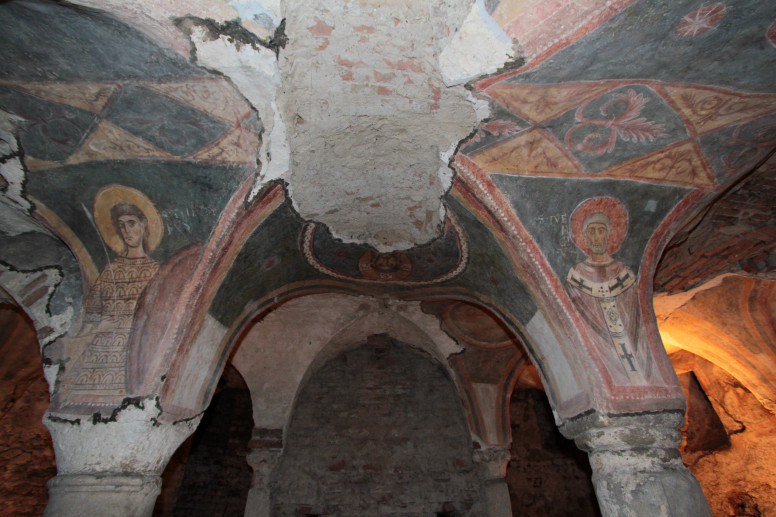
The CryptBeneath the presbytery lies the atmospheric crypt, divided into three aisles by numerous columns whose capitals are all different: some are reused from earlier buildings, while others are carved with winged dragons, human figures and intricate vegetal motifs.
The crypt also preserves a refined marble Madonna and Child, probably influenced by Tuscan sculpture, and the funerary monument of Blessed Martino Salimbene, a fifteenth-century notary from Pavia. Created in 1491, it is attributed to the workshop of Giovanni Antonio Amadeo.
Since 1614, the crypt has been dedicated to Saint Charles Borromeo.
Among the basilica's greatest artistic treasures is also the celebrated Cross of Teodote, an exquisite silver-plated crucifix crafted by a northern Italian goldsmith during the second half of the tenth century.
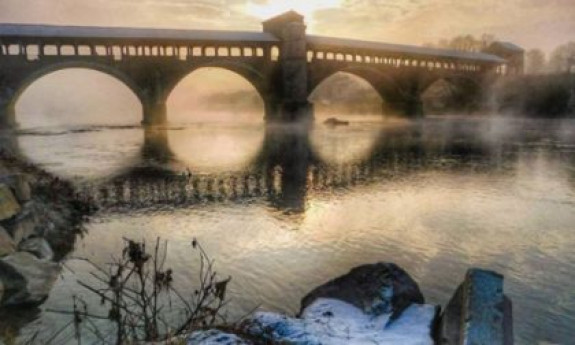
Visitor InformationThe Basilica of San Michele Maggiore is located in Piazza San Michele, in the heart of Pavia's historic centre, just a few minutes' walk from the Covered Bridge (Ponte Coperto) and the Visconti Castle.
The church is generally open every day, although opening hours may vary due to religious services or special events. Visitors are advised to check the basilica's official channels before planning their visit to confirm current opening times and any guided tours organised by the parish or local cultural associations.
To capture the best photograph of the façade of the Basilica of San Michele Maggiore, the ideal timing is very specific:
- From mid-September to mid-April: 45–60 minutes before sunset.
- From May to August: approximately 1 hour and 15 minutes before sunset.
The reason is that the main façade faces west, allowing it to be illuminated directly by the afternoon sun. As the sun lowers, the warm golden light enhances the sandstone and beautifully highlights the Romanesque carvings and sculptural details.
Why Visit the Basilica of San Michele Maggiore?A visit to the Basilica of San Michele Maggiore offers an extraordinary journey through the history of medieval Pavia, when the city was one of Europe's foremost political and religious centres. From its magnificent sculpted façade and remarkable Romanesque mosaics to its famous labyrinth and atmospheric crypt, every corner of the basilica tells a story spanning more than a thousand years.
Together with the Basilica of San Pietro in Ciel d'Oro, the Basilica of San Teodoro and Pavia Cathedral, San Michele Maggiore is an essential stop for anyone wishing to discover the rich artistic, historical and spiritual heritage of Pavia.
Opening hours
From Monday to Saturday 8 a.m. - 7 p.m.
On Sundays : 8 a.m. - 8 p.m.
Other links
Facebook